A new Parish Council for Margate
The council, at its extraordinary meeting on 18 June 2026, agreed to create a Parish Council for Margate.
A Shadow Town Council has now been created to ensure that the new Town Council will be safe and legal on vesting day – 1 April 2027.
Read the agendas and minutes of the Shadow Town Council
A copy of the Order is available, containing all of the details regarding the set-up of the new Parish Council.
Read the Order online (PDF)
Read the accessible version of the Order (Doc)
PermalinkA Shadow Town Council will be set up to assist in the creation of the Town Council. This will deal with administrative tasks to ensure that the new Town Council is safe and legal on day one. It would then cease to exist on the day the new Town Council comes into existence.
The Town Council would formally come into existence on Wednesday 1 April 2027. Elections to the Town Council would then take place on the first Thursday in May 2027.
PermalinkAnalysis of 2nd Stage Consultation
The second stage consultation was completed by 476 people, 475 online and one in paper form.
Of the 476 respondents:
- 458 identified as living in Margate.
- 104 identified as working in Margate
- 241 identified as going out in Margate
- 136 identified as visiting friends and or family in Margate
- 44 identified as owning a business in Margate
- 69 identified as volunteering for an organisation in Margate
*People could select more than one answer.
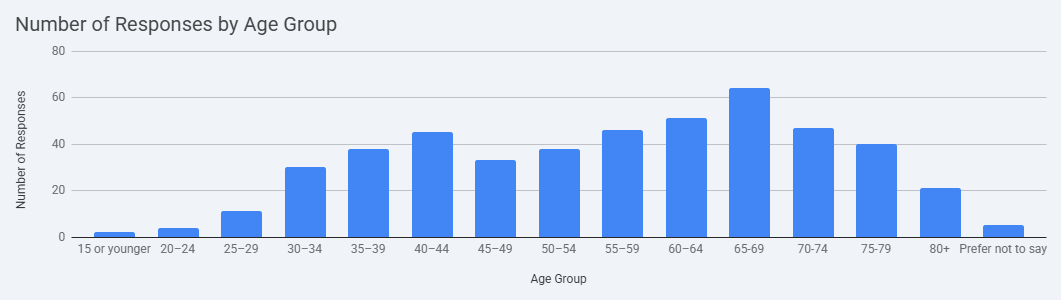
Age
Age group |
Number of responses |
| 15 or younger | 2 |
| 20–24 | 4 |
| 25–29 | 11 |
| 30–34 | 30 |
| 35–39 | 38 |
| 40–44 | 45 |
| 45–49 | 33 |
| 50–54 | 38 |
| 55–59 | 46 |
| 60–64 | 51 |
| 65-69 | 64 |
| 70-74 | 47 |
| 75-79 | 40 |
| 80+ | 21 |
| Prefer not to say | 5 |
Do you agree with the decision to create a Parish Council for Margate and to call it ‘Margate Town Council’?
Response |
Count |
Percentage |
| Strongly agree | 317 | 66.7% |
| Agree | 99 | 20.8% |
| Neither agree nor disagree | 26 | 5.5% |
| Disagree | 2 | 0.4% |
| Strongly disagree | 31 | 6.5% |
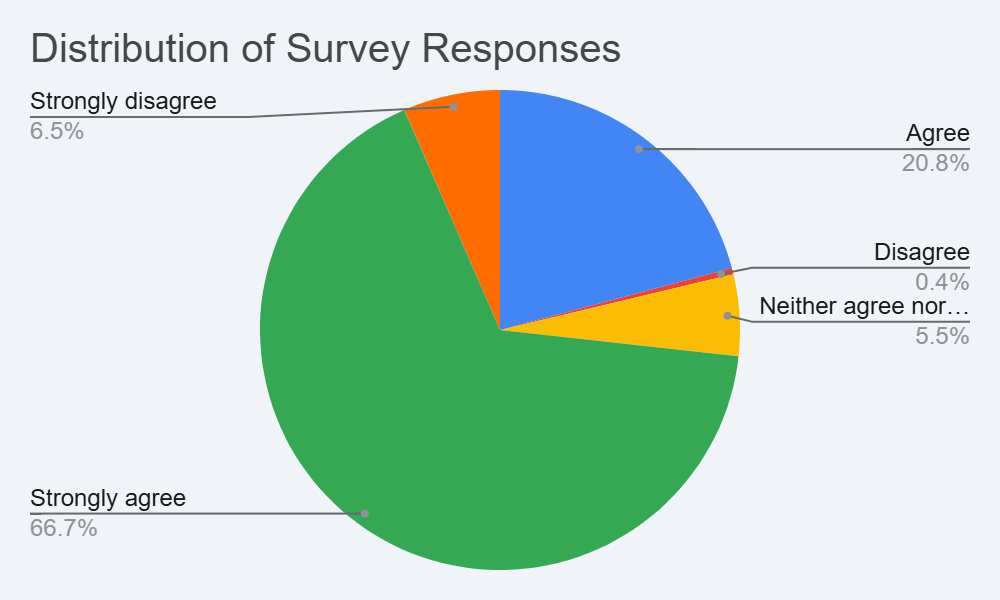
87.5% of respondents agreed with our decision to create a Parish Council for Margate and to call it ‘Margate Town Council’.
Of those that responded negatively to this question, the overwhelming response was to object to the principle of a Town Council, rather than to suggest alternative names for the council.
A warded Parish or a single large Parish?
Response |
Count |
Percentage |
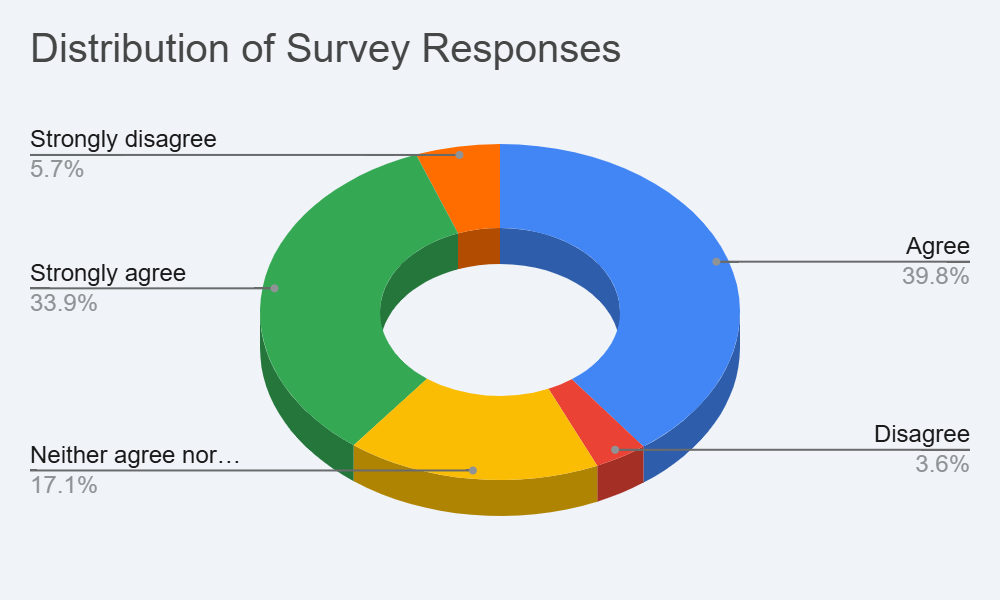
| Strongly agree | 161 | 33.9% |
| Agree | 189 | 39.8% |
| Neither agree nor disagree | 81 | 17.1% |
| Disagree | 17 | 3.6% |
| Strongly disagree | 27 | 5.7% |
The majority of the 475 respondents either Agree (39.8%) or Strongly agree (33.9%) with the proposal to divide the new Town Council into wards, resulting in a combined total of 350 responses (73.7%) in favour.
Forty-four people gave further details as to why they did not agree with a warded Parish Council.
- A majority of the 44 respondents used this question to voice their general opposition to the creation of a Town Council entirely, rather than just the issue of wards.
- An argument was made for keeping Margate as one community to avoid fragmentation and internal competition.
- Some suggested that dividing the area would create a “lack of focus/direction” or competition for funds and resources.
- Several comments suggested that having one large ward would be simpler, more efficient, and lead to better overall management.
There was a further opportunity for all respondents to comment on the warding proposals. 157 of the 475 respondents chose to answer this question and again some took the opportunity to restate their opposition to the principle of a Parish Council. Some respondents explicitly supported the split into wards, stating that it would allow for “specific attention unique to their own location,” improve accountability, and enable a better understanding of diverse community needs. However there were a similar number expressing the opposite: that splitting the town could lead to unequal representation, funding disparities, or favouritism towards certain wards.
Names of the wards
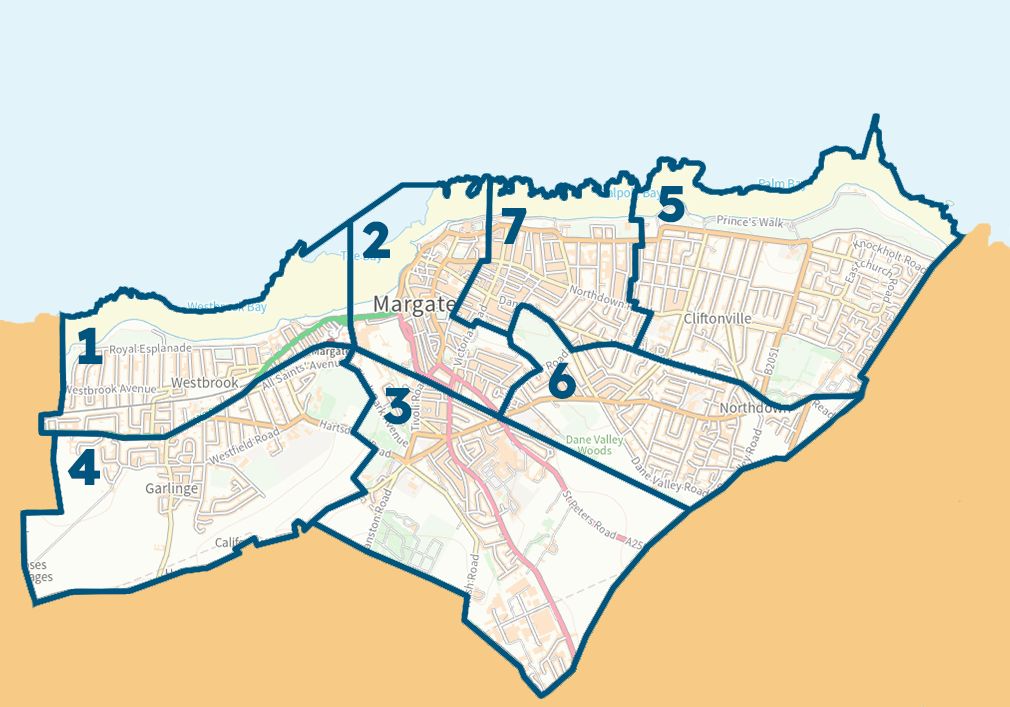
We are proposing the Parish has seven wards and these are named: Westbrook, Garlinge, Margate Central, Cliftonville West, Cliftonville East, Dane Valley and Salmestone.
Response |
Count |
Percentage |
| Strongly agree | 165 | 34.7% |
| Agree | 200 | 42.1% |
| Neither agree nor disagree | 70 | 14.7% |
| Disagree | 13 | 2.7% |
| Strongly disagree | 27 | 5.7% |
76.8% of respondents either agreed or strongly agreed with our proposed names of the wards.
There were no suggestions for alternative names of wards.
Number of Councillors per ward
Thanet District Council proposed the following number of Councillors for each ward:
Ward |
Number of Cllrs |
|
| 1 | Westbrook | 2 |
| 2 | Margate central | 2 |
| 3 | Salmestone | 3 |
| 4 | Garlinge | 3 |
| 5 | Cliftonville east | 3 |
| 6 | Dane Valley | 3 |
| 7 | Cliftonville west | 3 |
Totals |
19 |
The consultation gave the following results:
Response |
Count |
Percentage |
| Agree | 219 | 46.11% |
| Strongly agree | 115 | 24.21% |
| Neither agree nor disagree | 78 | 16.42% |
| Strongly disagree | 36 | 7.58% |
| Disagree | 27 | 5.68% |
Only 13.26% disagreed or strongly disagreed with the number of Councillors Thanet District Council was proposing for each ward.
Any other comments?
Out of the 475 responses, a total of 361 entries (76%) to the question “Do you have any further comments to add about any of the proposals?” were either blank or indicated that the respondent had no further comments to make.
The remaining comments were on a mixture of topics. Thirty-one respondents used the opportunity to state that they were in favour of the proposals and a similar number re-stated their objection to the whole proposals or that it would be a waste of money.
Some felt that there was insufficient information in the form to be able to make an informed decision. In addition there were also a handful of comments that queried how the council had decided on the number of Councillors for each ward.
PermalinkSurvey results: creating a new Parish Council
When did it happen?
We asked the public for their opinion starting on 15 August 2025. This survey (called a consultation) lasted for six weeks and finished on 28 September 2025.
How many people answered?
We received 773 responses in total. The team in charge (Democratic Services) is happy with this result. They looked at other similar reviews (called Community Governance Reviews), and this number of replies is similar to those.
What did people say?
The first question was about starting a new Parish Council. Most people thought this was a good idea.
- 700 people agreed or strongly agreed with the idea.
- Only 57 people disagreed or strongly disagreed.
The results in percentages:
- 90.6% agreed or strongly agreed.
- 7.4% disagreed or strongly disagreed.
- 2% remained neutral (they didn’t pick a side).
Table 3
Opinion |
Number |
| Strongly disagree | 48 |
| Disagree | 9 |
| Neither agree nor disagree | 16 |
| Agree | 71 |
| Strongly agree | 629 |
Table three shows the results of the survey about starting a new local council.
- Almost everyone said yes:
- 629 people said they strongly agreed.
- 71 people said they agreed.
- In total, 700 people were in favor of the new council.
- Only a small number of people said no:
- 48 people said they strongly disagreed.
- 9 people said they disagreed.
- 16 people were neutral, meaning they chose ‘neither agree nor disagree’.
Who answered the survey?
When we looked at the age of the people who answered, most of the replies came from adults between 34 and 54 years old. But it’s important that we heard from people of all ages, from 16 years old all the way up to people over 80.
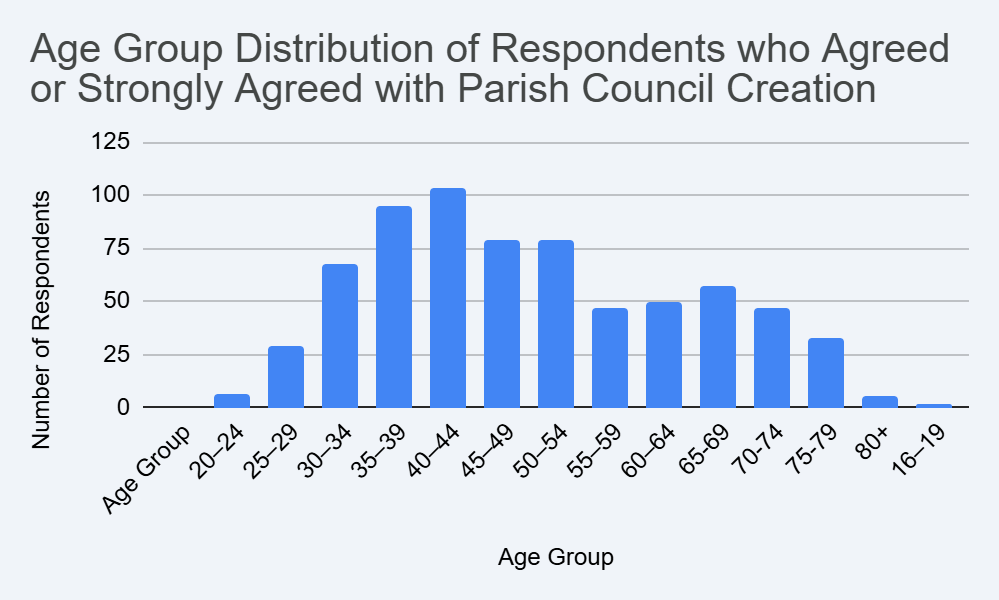
The survey was open to all, and people could choose more than one option to describe their connection to Margate.
The most common answer, which supports the council’s position, was “I live in Margate.”
- Out of the total 773 people who answered, 683 (88%) said they live in Margate.
- The second most common answer was “I go out in Margate,” chosen by 415 (54%) people.
The full breakdown of how all respondents described their relationship with Margate (they could select multiple options) is:
Table 4
Criteria |
Number |
| I live in Margate | 683 |
| I go to school in Margate | 5 |
| I work in Margate | 256 |
| I own a business in Margate | 129 |
| I volunteer for an organisation in Margate | 148 |
| I go out in Margate | 415 |
| I visit friends and/or family in Margate | 232 |
| I visit Margate for holidays | 17 |
| I visit Margate for business | 34 |
To understand the survey results better, we compared the overall opinions (Table 3) with who answered the survey (Table 4). This comparison shows how different groups of people feel about the proposal. It confirms the strong support for the new Parish Council because the data now clearly shows that it is Margate residents who are strongly in favour, and not just visitors, with residents being against.
Table 5
Reason |
Strongly agree |
Agree |
Neither agree nor disagree |
Disagree |
Strongly disagree |
| I live in Margate | 562 | 65 | 13 | 5 | 38 |
| I go to school in Margate | 5 | 0 | 0 | 0 | 0 |
| I work in Margate | 219 | 16 | 6 | 4 | 11 |
| I own a business in Margate | 109 | 10 | 2 | 2 | 6 |
| I volunteer for an organisation in Margate | 134 | 5 | 2 | 1 | 6 |
| I go out in Margate | 346 | 38 | 10 | 4 | 17 |
| I visit friends and/or family in Margate | 189 | 18 | 6 | 5 | 14 |
| I visit Margate for holidays | 14 | 1 | 1 | 0 | 1 |
| I visit Margate for business | 28 | 2 | 1 | 0 | 3 |
The survey gave people a space to write their own thoughts on why they did or did not support creating a new Parish Council.
The main reasons people gave for supporting a new Parish Council were:
- Community: People strongly want the new council to increase local involvement and support for the community.
- Local voice: Many feel a parish council would give local people more power and a stronger say in decisions about Margate.
- Local control: A common point was the need for the area to have more local control over its money and decision-making.
- Better services: People believe a parish council would bring better funding, better services, and better representation for Margate and its residents.
The main reasons people gave for not supporting a new Parish Council were:
- Cost: Many people worried about the financial cost of a new council, especially fearing higher council tax.
- Too much paperwork: Some people felt a new council would just create extra bureaucracy and do the same work as existing councils.
- Not effective: Some people said they didn’t trust another council to be effective or genuinely improve the area and fix existing problems.
- Current councils are enough: A number of people said the existing Thanet District Council and Kent County Council already do a good enough job, so a new council is not needed.
- No real benefit: Several people doubted the concrete benefits of a Parish Council for Margate, believing it wouldn’t create positive change.
It is important to note that the positive themes listed above came from a total number of answers that was ten times larger than the total number of answers for the negative themes.
A full set of answers to the qualitative questions in the consultation is available to read.
PermalinkTown or parish councils are the first tier of local government. They are made up of elected Councillors who represent the local community.
A town or parish council would:
- be a separately elected body of councillors representing the communities of Margate. Elections take place every four years
- have powers to deliver local services or support initiatives, subject to available resources
- have the ability to raise a precept (an additional amount added to Council Tax) to pay for the activities it carries out
Town and parish council activities usually fall into three categories:
- delivering services like parks and play areas
- giving the community a voice and representing local people
- improving quality of life and wellbeing in the local community
Town and parish councils can own land and buildings. They can provide or manage certain local public services, such as grass cutting, litter bins, street lighting, parks and playgrounds, community buildings and allotments. They play a part in community representation and local administration, reflecting a distinctive community identity.
Parish councils are also consulted on local planning applications within their area and can make recommendations, but they do not have the power to make planning decisions. Parish councils often use their powers to supplement services already provided by a district or county council (principal council).
For example, a parish council might provide extra litter bins to supplement the ones provided by the area’s principal council. The town or parish council would pay for these.
Occasionally, a parish council might deliver services on behalf of a principal council.
Town and parish councils have the power to raise money through the local Council Tax. The average Council Tax precept for parish and town councils in Thanet in 2025/26 is £64 per year, or £1.23 per week. This money pays for the local services delivered by town and parish councils.
There is more information on how your Council Tax is spent on our website.
You can learn more about parish and town councils on the National Association of Local Councils website.
PermalinkA parish council for Margate would need to have a set boundary. The outer boundary is set by the existing town and parish councils that border Margate. This is shown on this map. Any new parish council for Margate could include all or part of this area.
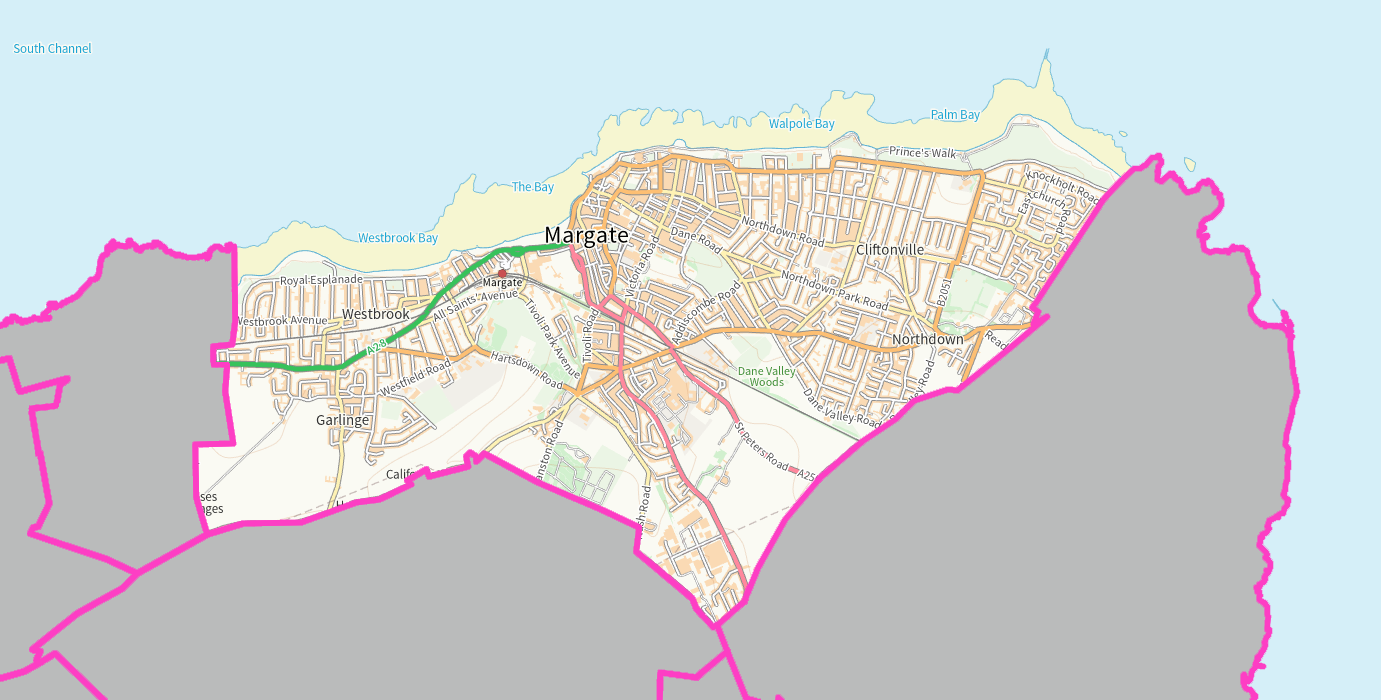
Map showing the proposed boundaries for Margate Town Council, which divide the town into seven numbered zones.
Community Governance Reviews (CGR) are a process where councils can consult on local governance arrangements, including creating new parish or town councils.
Margate does not currently have a parish or town council, unlike every other town and village in the district. Services for Margate are provided directly by both Thanet District Council and Kent County Council.
In July 2025, District Councillors agreed to ask residents whether they feel it is time to create a new town or parish council for Margate.
PermalinkBEAWP 4 June 2026
Council 8 January 2026
BEAWP 3 December 2025
- Agenda for BEAWP on Wednesday 3 December 2025, 4pm – Thanet
- Minutes of BEAWP on Wednesday 3 December 2025, 4pm – Thanet
BEAWP 30 October 2025
- Agenda for BEAWP on Thursday 30 October 2025, 4pm – Thanet
- Minutes of BEAWP on Thursday 30 October 2025, 4pm – Thanet
Council 15 July 2025
- Agenda for Council on Thursday 10 July 2025, 7pm – Thanet
- Minutes of Council on Thursday 10 July 2025, 7pm – Thanet